🚗 Mileage alone no longer tells the full story of an EV’s battery condition.
There are many factors influencing State-of-Health (SoH) degradation in EV batteries.
The most obvious one is also the easiest to observe: Mileage 🛣️
At Bib, we analyzed data from 10,000+ electric vehicles.
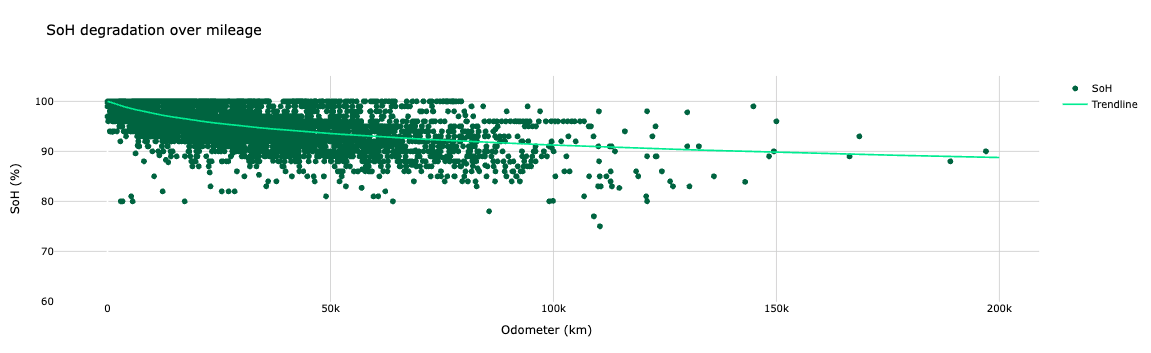
One result stands out: 46% of State-of-Health (SoH) variation is directly linked to mileage.
Which means that 54% is not linked to mileage!
The relationship, however, isn’t linear. Battery degradation follows a logarithmic pattern: SoH degradation is generally faster in the first ≈20,000 km, then slows down (see graph below).
This has two key implications:
1) SoH for buyers
A used EV with ≈30,000 km has already passed its steepest degradation phase. After that point, SoH tends to decline more gradually, which can make a used vehicle a more efficient option from a battery lifespan perspective.
On average, an EV with 200,000 km still has 87% SoH.
2) SoH for fleets
Early usage matters. Managing driving and charging patterns during the first kilometers can help preserve battery health and improve residual value over time.
Takeaway
A well-chosen used EV can offer excellent State-of-Health (SoH) and long-term value.
Mileage is just one piece of the puzzle. Factors such as temperature, charging cycles or depth of discharge also play critical roles.
Read the last posts

What is a battery?

The environmental impact of batteries