Does driving faster reduce EV range?

Does driving faster reduce EV range?
Yes. And by more than most drivers expect. We analyzed over 5,000 real driving phases on a Tesla Model Y Long Range 2025 to measure exactly how much.
The data: range by speed segment
We analyzed over 5,000 real driving phases on a Tesla Model Y Long Range 2025, grouped by speed segment. The result is a clear picture of how driving behavior directly impacts range.
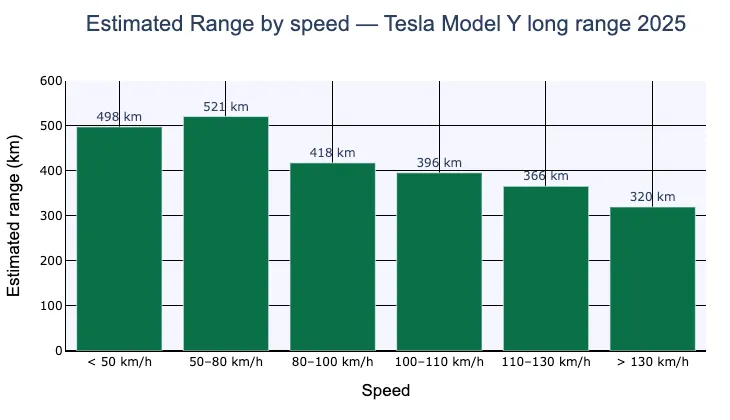
Estimated Range by speed - Study by Bib batteries
Finding 1: highway driving costs you 150 km
Driving above 110 km/h gives you roughly 320 to 366 km of range. In urban driving below 80 km/h, that same battery delivers 498 to 521 km. The gap is close to 150 km, which represents nearly 30% range loss.
Aerodynamic drag increases with the square of speed. At 130 km/h, the motor works much harder than at 80 km/h. The battery discharges faster, and the rated range simply does not apply.
Finding 2: speed is one of the main drivers of battery health
SoH (State of Health) measures how much usable capacity remains in a battery compared to its original spec. A lower SoH directly means shorter range. And SoH is not just about age or mileage. It is shaped by how the vehicle is driven.
Sustained high-speed driving generates more heat and puts the battery under continuous high-load discharge. Combined with repeated sharp accelerations, this accelerates degradation over time. A battery test (SoH test) on two identical vehicles with different driving profiles will often show a measurable difference in battery health.
This is why at Bib batteries, we assess battery health based on real usage data, not just mileage or age.
Why range peaks between 50 and 80 km/h
One observation worth noting: the highest estimated range in our data is 521 km, recorded in the 50-80 km/h segment, slightly above the sub-50 km/h segment (498 km).
At very low speeds (under 50 km/h), stop-and-go patterns, accessories, and HVAC systems consume a disproportionate share of energy. Between 50 and 80 km/h, the motor runs at a stable and efficient operating point, with low aerodynamic drag and reduced parasitic losses. This is the sweet spot for range.
What this means for buyers and fleet operators
If you are buying a used EV or managing a fleet, range anxiety often starts with a battery health question. The real range a vehicle delivers depends on two things: its SoH, and how it will be driven.
A vehicle with 90% SoH driven mostly at highway speed can deliver less practical range than a vehicle with 85% SoH used in urban cycles. This is why a proper battery health test must account for usage context, not just remaining capacity.
Key takeaways
- Driving above 110 km/h reduces range by up to 30% vs urban driving
- The 50-80 km/h range is the most efficient speed segment for EVs
- SoH degradation is accelerated by sustained high-speed and high-load driving
- A battery health test on the same model can show different results based on driving history