EV Battery Buffer: What Happens When Your Car Hits 0% State of Charge?


EV Battery Buffer: What Really Happens When Your Car Hits 0% State of Charge?
You glance at the dashboard: 0% battery. But your EV is still moving. What’s going on - and how far can you actually go?

0% doesn’t mean empty
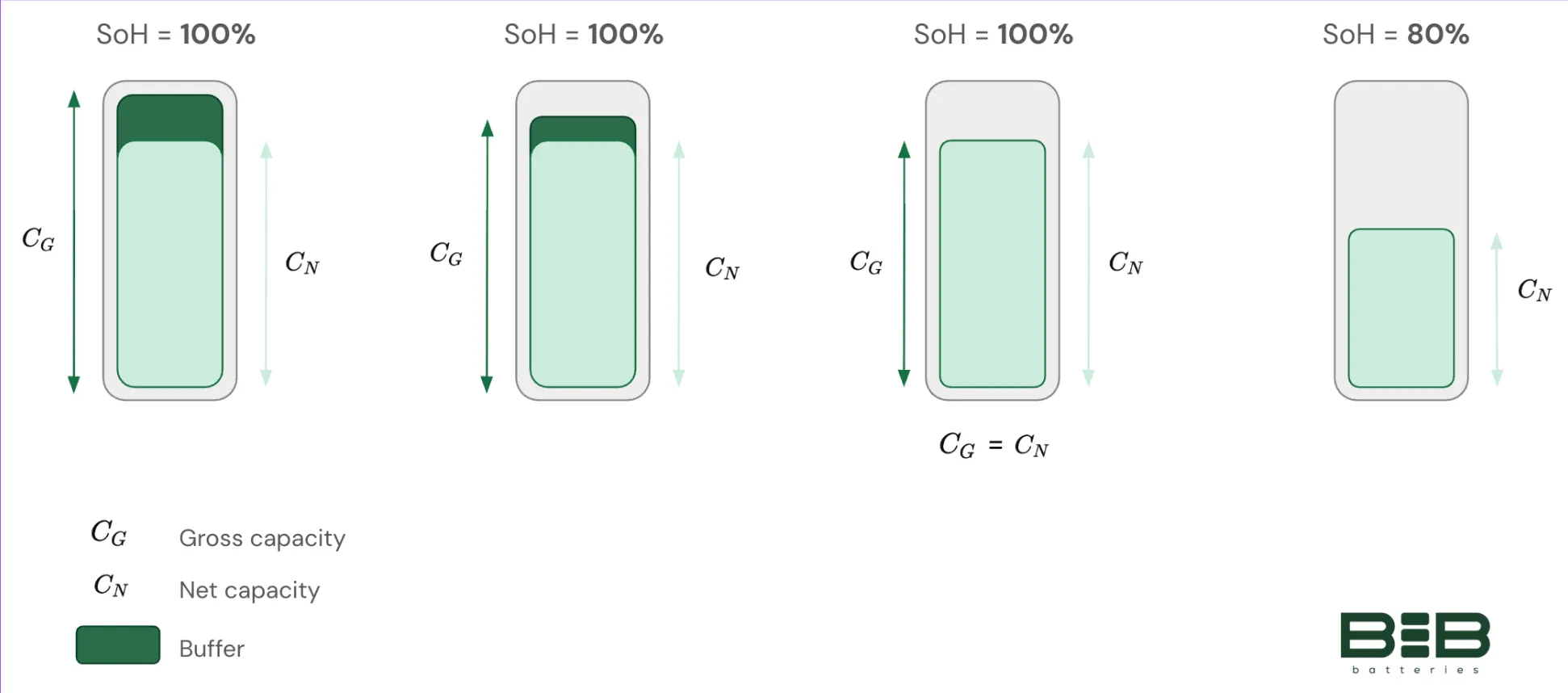
Most EV drivers assume that when the State of Charge (SoC) display reads zero, the battery is truly depleted. In reality, manufacturers deliberately reserve a portion of the battery’s gross capacity - a hidden buffer that the driver never directly accesses through normal use.
Using a dataset of 250 Tesla Model Y Long Range vehicles (2025, MTY29, ≈78 kWh gross), the data shows a clear pattern: at 100% SoC, roughly the full 78 kWh is available. At 0% SoC, approximately 3.5 kWh remains - about 4.5% of total capacity kept permanently in reserve.
This is the core reason why a car’s “net” (usable) battery capacity is always lower than its “gross” capacity. The difference is the EV battery buffer.
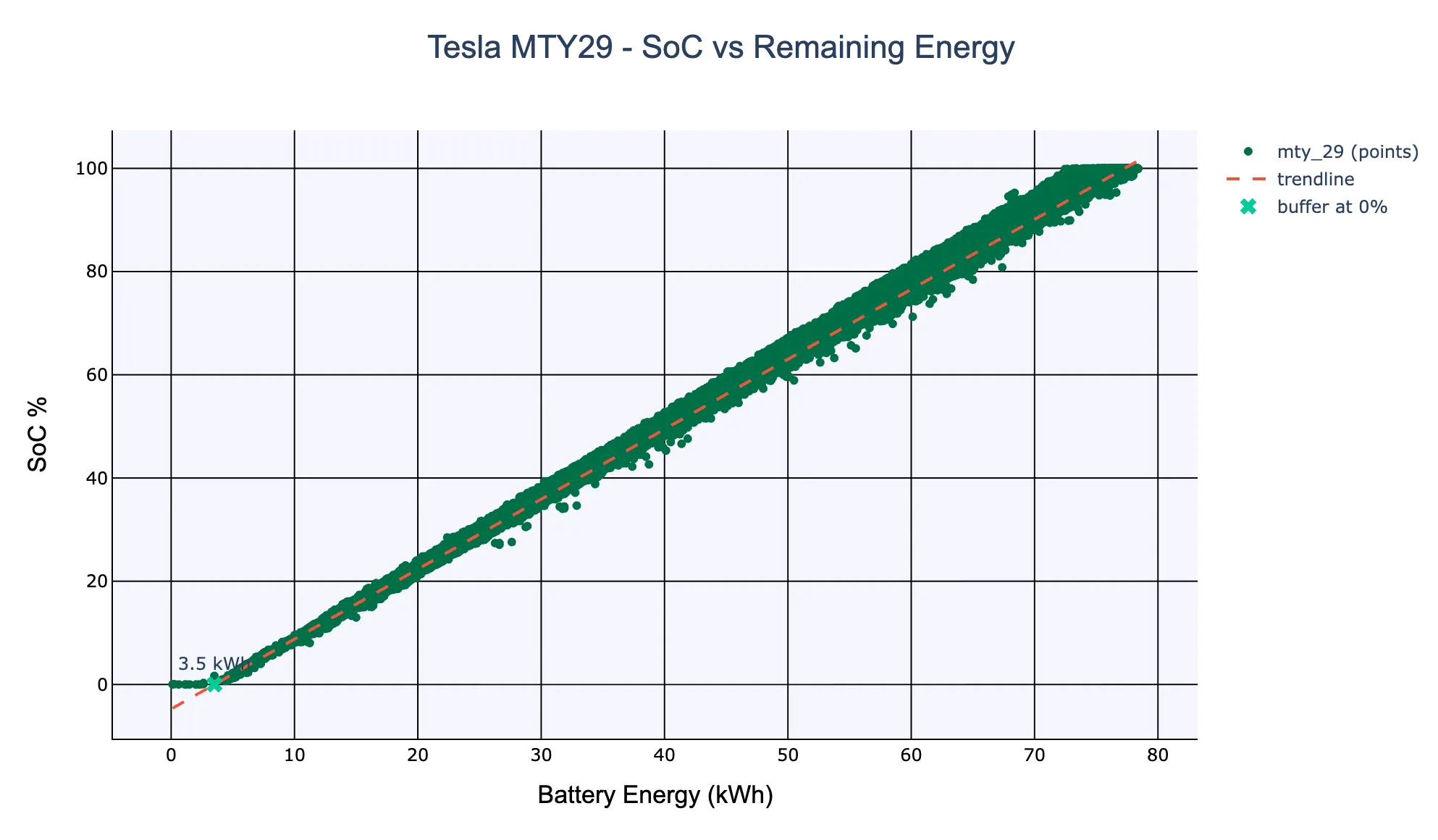
Bib batteries: Tesla MTY29 - SoC vs Remaining Energy
Why do EVs have a battery buffer?
- Keep critical systems alive: Even at 0% SoC, the vehicle must be able to unlock, communicate, and respond to the owner. A completely dead battery would render the car inaccessible.
- Protect battery State of Health (SoH): Deep discharges are one of the most damaging events for lithium-ion chemistry. The buffer prevents the cells from reaching critically low voltage levels that would permanently degrade battery State of Health and reduce long-term EV battery range.
- Provide a real-world safety margin: Range estimates are based on average conditions. Temperature, driving style, elevation, and auxiliary load all affect actual EV battery range. The buffer acts as an invisible cushion when reality diverges from prediction.
How far can you actually drive past 0%?
Analysis of real-world driving data shows a significant number of drivers continued driving well after the display reached 0%. In multiple cases, vehicles travelled more than 20 additional kilometres before stopping - all drawing on that 3.5 kWh reserve.
This isn’t a manufacturer trick or a hidden feature. It’s an engineered safety net built into every modern EV to protect both the battery and the driver. However, regularly relying on this reserve is not recommended: it stresses the cells at their lowest voltage point, which over time can accelerate degradation and reduce overall State of Health.
Practical tip: Think of 0% displayed SoC the way you think of the fuel warning light in a combustion car - it signals a true emergency reserve, not a safe daily stopping point.
Buffer, SoC, and SoH: understanding the full picture
Three battery metrics are often confused but each plays a distinct role:
- State of Charge (SoC): the current energy level, expressed as a percentage of usable (net) capacity. What you see on the dashboard.
- EV battery buffer: the portion of gross capacity intentionally withheld from the usable range. Hidden from the driver, but always present.
- State of Health (SoH): how much of the original gross capacity the battery still holds after ageing and charge cycles. A battery at 90% SoH has less gross capacity than when new - meaning both usable range and the buffer shrink over time.Monitoring SoH is therefore essential for understanding the true long-term trajectory of your EV battery range - not just the daily SoC percentage.