
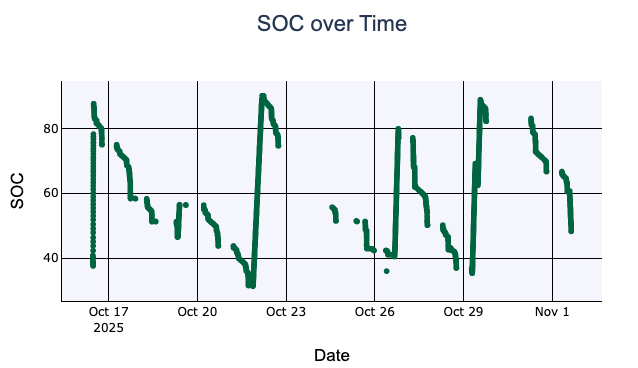
EV Battery Charge-Discharge Cycles: How It Works and Why It Matters
Understanding what happens inside your EV battery with every charge and drive, and how to make it last longer.
Introduction
Every time you plug in your electric vehicle and every time you drive it, your battery goes through a charge-discharge cycle. This process is fundamental to how lithium-ion batteries work, and understanding it is key to making informed decisions about battery management, fleet operations, and end-of-life assessment.
In this article, we break down the electrochemistry behind charge-discharge cycles, explain the key metrics that govern battery behavior (SoC, DoD), and explain what deep discharge really means for battery longevity.
What Is a Charge-Discharge Cycle?
A full cycle consists of one complete charge followed by one complete discharge: from 0% to 100%, then back to 0%. In practice, most EV users never go from 0 to 100%, so a "cycle" is typically counted as the equivalent of a full charge, regardless of how it's split across multiple partial charges.
This distinction matters: it's cumulative energy throughput, not the number of plug-ins, that drives battery aging.
The Charging Phase: Storing Energy Chemically
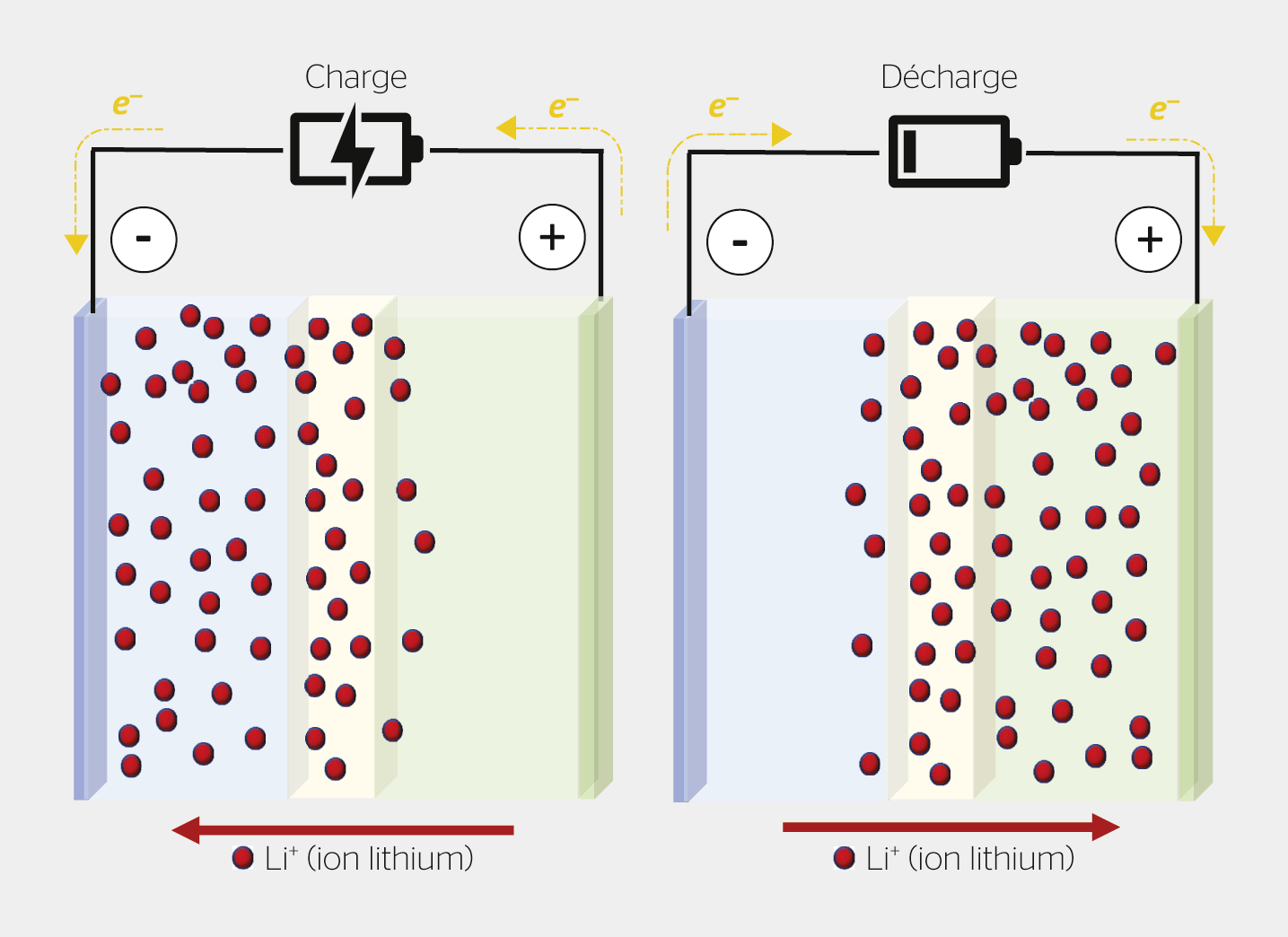
When you plug your EV into a charger, whether AC (Alternating Current, typical of home and Level 2 chargers) or DC (Direct Current, used in fast chargers), electrical energy drives lithium ions from the positive electrode (cathode) back toward the negative electrode (anode), where energy is stored in chemical form.
AC vs. DC charging: With AC charging, the vehicle's onboard converter transforms the current before it reaches the battery. With DC fast charging, current is delivered directly at higher power, which is why thermal management becomes critical during fast charging sessions.
The Discharge Phase: Converting Chemical Energy into Motion
When the vehicle is in motion, the process reverses. Lithium ions migrate from the anode through the electrolyte toward the cathode, generating the electric current that powers the motor.
The harder the vehicle works, the faster the discharge: rapid acceleration, hill climbing, or towing demands a high ion flux, depleting the battery faster. Smooth, steady driving draws far less current, which is why driving style has a measurable impact on both range and long-term battery longevity.
The Role of the BMS (Battery Management System)
The BMS (Battery Management System) is the brain of the battery pack. It continuously monitors and controls temperature, current flow, and individual cell voltages, enforcing safe operating limits to prevent overcharge and deep discharge.
Critically, the BMS also manages charging power as a function of SoC: when the battery is nearly full, the BMS progressively reduces charging power to protect the cells, which is why the last 20% of a charge always takes longer. This tapering is by design and essential for longevity.
State of Charge (SoC): The Battery's Fuel Gauge
SoC is the percentage of energy currently stored relative to full capacity, ranging from 0% (depleted) to 100% (full). It sounds simple, but measuring it accurately is technically challenging, particularly for LFP (Lithium Iron Phosphate) batteries, whose flat voltage curve makes estimation significantly harder than for NMC chemistries.
Several methods exist to measure SoC with varying degrees of precision: OCV (Open Circuit Voltage), Coulomb Counting, and Kalman Filtering, each with its own trade-offs in accuracy and complexity.
Depth of Discharge (DoD): The Other Side of the Equation
DoD is the complement of SoC: it measures how much of the battery's total capacity has been used: DoD + SoC = 100%
The deeper a battery is regularly discharged, the faster it ages. A battery cycled consistently to 80–100% DoD will complete far fewer total cycles before significant degradation compared to one kept within a 20–80% SoC window.
For fleet operators, monitoring average DoD across a vehicle's lifetime is one of the strongest predictors of remaining useful life.
.png)
What Is Deep Discharge, and Why Is It Damaging?
Deep discharge occurs when SoC falls below a critical threshold, typically below 10–15% for lithium-ion batteries. At this point, unfavorable electrochemical conditions can cause permanent damage:
- Electrode damage: irreversible reactions alter electrode structure, permanently reducing lithium-ion storage capacity
- Capacity loss: the battery progressively loses its ability to hold a full charge
- Copper dissolution: in extreme cases, the copper current collector can dissolve and redeposit internally, creating short-circuit risks
Modern BMS systems include hard voltage cutoffs that prevent deep discharge under normal use. However, batteries left unused for extended periods in storage, end-of-life inventory, or decommissioned fleets can self-discharge into deep discharge territory without any user intervention. This is a critical risk for anyone managing battery assets at scale.
How Cycles Impact Battery State of Health (SoH)
Each cycle causes microscopic wear to electrode materials. Over thousands of cycles, this cumulative degradation reduces total capacity, which is why State of Health (SoH) declines.
Degradation is non-linear: SoH degradation tend to be faster in the first months of use, then slowing significantly before potentially accelerating again near end-of-life. Operating conditions (temperature, charge rate, DoD, and SoC window) have a major cumulative impact on how quickly this degradation occurs.
Key Takeaways for EV Owners
- Daily charge level: Keep between 20-80% SoC
- Fast charging frequency: Minimize DC fast charging when possible
- Depth of discharge: Avoid regularly discharging below 15-20%
- Temperature: Avoid prolonged exposure to extreme heat or cold
- Storage: Try storing your EV at 40-50% SoC if it is inactive.
- Monitoring: Track SoC, DoD and cycle count to anticipate battery degradation.
Conclusion
The charge-discharge cycle is the heartbeat of every EV battery. Understanding its mechanics, from ion migration to BMS management to the risks of deep discharge, is essential for anyone responsible for battery assets, whether managing a fleet, assessing a used vehicle, or planning end-of-life operations.
The better a battery is operated within its design parameters, the longer it will perform.


%20(1).jpg)