What is battery SoC?


SoC stands for state of charge. It is the proportion of energy in a battery at a given moment relative to its fully charged state, ranging from 0% to 100%.
💡Accurately determining the SoC helps improve system performance and battery lifespan 𝗯𝘆 𝗽𝗿𝗲𝘃𝗲𝗻𝘁𝗶𝗻𝗴 𝗼𝘃𝗲𝗿𝗰𝗵𝗮𝗿𝗴𝗶𝗻𝗴 𝗼𝗿 𝗱𝗲𝗲𝗽 𝗱𝗶𝘀𝗰𝗵𝗮𝗿𝗴𝗶𝗻𝗴.
Depending on the SoC, the charging power varies: when the SoC is low, the battery can safely accept high charging power. Conversely, as the SoC increases and the battery approaches full charge, the charging power is gradually reduced to prevent overheating and to protect the cells.
To calculate SoC, two main methods exist:
1️⃣ 𝗢𝗽𝗲𝗻 𝗖𝗶𝗿𝗰𝘂𝗶𝘁 𝗩𝗼𝗹𝘁𝗮𝗴𝗲 (OCV): Linking the battery’s voltage to its state of charge
The voltage at the battery terminals rises or falls depending on its charge level. It is highest when the battery is fully charged.The SoC can be checked through a controlled discharge test.
The voltage-based method estimates SoC by converting the battery’s measured voltage into an equivalent charge level using its specific discharge curve. This method faces challenges because battery voltage can be unstable, the discharge test is slow and usually requires recharging afterward, and the system cannot operate during the test (offline method).🔋 LFP batteries also have a relatively flat charge/discharge curve, which means the terminal voltage changes very little across a wide operating range, making it difficult to accurately measure the SoC.
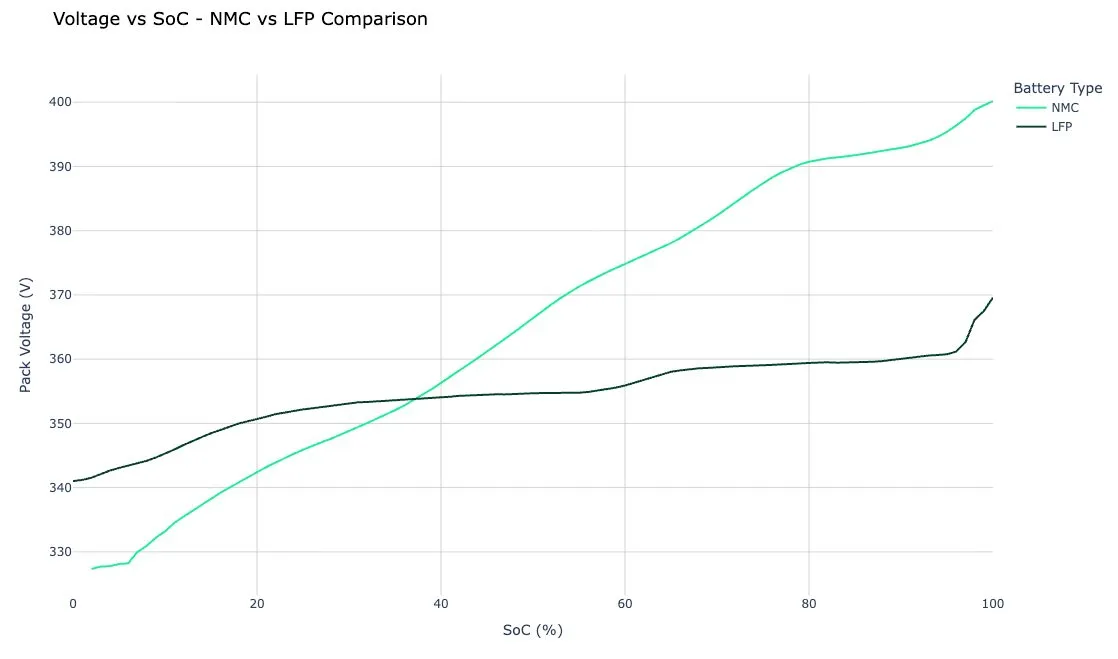
Data based on:- 9,033,055 points from NMC batteries with 79 kWh net capacity- 11,599,607 points from LFP batteries with 60 kWh net capacity.
2️⃣ 𝗖𝗼𝘂𝗻𝘁𝗶𝗻𝗴 𝗖𝗼𝘂𝗹𝗼𝗺𝗯 𝗺𝗲𝘁𝗵𝗼𝗱
This method basically works by tracking the electrons that enter the battery during charging and leave during discharging.
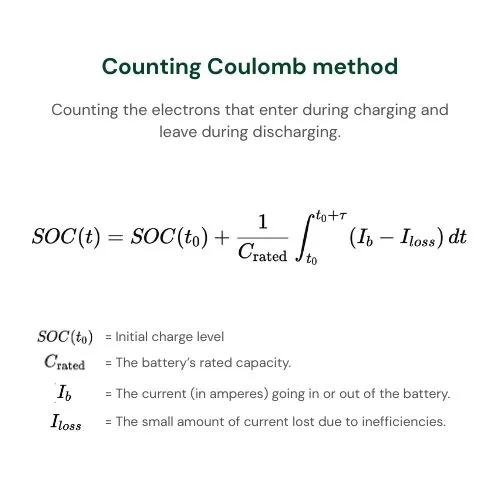
The formula calculates SoC by integrating the battery’s current (in amperes) over time, adding all the charge that enters and subtracting all the charge that leaves, while accounting for the battery’s rated capacity and energy losses.To work well, this method needs two things:- accurate current measurements- a good estimate of the starting SoC.However, real batteries are not perfect. Some energy is always lost during charging and discharging, and there is also self-discharge. These losses slowly create errors in the calculation.